
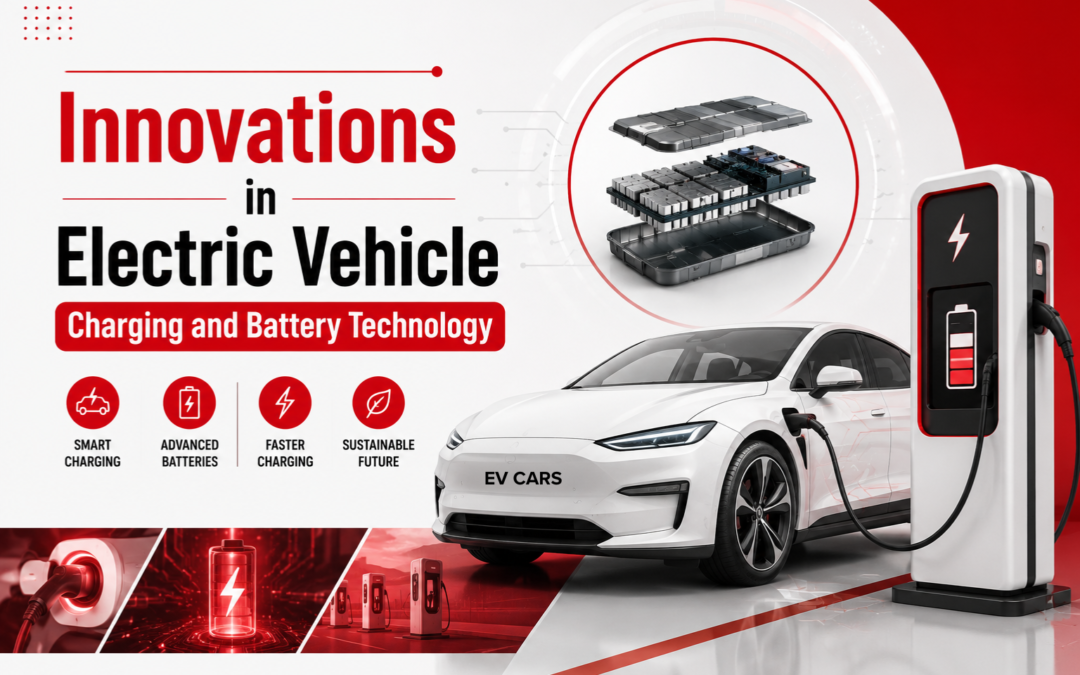
Today, electric vehicles — an active street mobility technology — are the evolution of modern transportation. Now, manufacturers are chasing fast charging, battery performance, and driving range. This demand keeps manufacturers unleashing even smarter solutions year on year. The newest technology in electric vehicle charging and battery technology is making EV sales easier, cheaper, and enabling more people to travel sustainably across the globe. Such advances additionally allow governments to ful-fill clean energy objectives. Consequently, the EV industry is booming everywhere in the world.
Latest Innovations in Electric Vehicle Fast Charging
Waiting time is now cut down considerably with fast charging systems. Old size EV chargers needed several hours to fully charge these batteries. But newer ultra fast chargers allow delivery of power in just minutes. This is a big improvement for EV owners who travel with long distances.
Smart Charging Networks for Better Efficiency
Smart charging systems leverage AI and cloud-based software to intelligently manage electricity demand. These also help flatten energy demand characteristics during peak consumption periods. So drivers receive consistent charging without stressing power grids.
Key advantages include:
- Faster charging management
- Better energy distribution
- Reduced electricity waste
- Improved charging station reliability
Today, lots of organizations set smart chargers in homes, workplaces, freeways and malls. As a result, daily commuters will find it even easier to access charging.
Wireless Charging Technology for Electric Vehicle Users
With options to a great extent expansion provided by wireless charging which is free of physical wires attached to your electric devices. Drivers simply leave the car parked over a charging pad. Energy would then transfer directly to the battery using electromagnetic fields.
This technology offers several benefits:
- Cleaner charging experience
- Reduced cable damage
- Better convenience for drivers
- Safer charging in public areas
Wireless charging is still a work in progress, though the technology has been successfully tested by nearly all automotive brands. Thus, analysts predict a far more widespread adoption in the future.
Latest Innovations in Battery Technology for Electric Vehicle Growth
The greatest part of EV development still concerns battery performance. Batteries now occupy a smaller space whilst storing more energy. Also, manufacturers also continuing to make battery safety and durability better.
Solid State Battery Technology for EV Performance
Solid state batteries are one of the most exciting innovations in the present. These batteries use solid electrolytes rather than liquid materials as with classic lithium ion batteries. This means is much safer and higher energy density.
Important benefits include:
- Faster charging speed
- Longer battery lifespan
- Improved fire resistance
- Higher driving range
Numerous automotive manufacturers are putting a lot of money into solid state battery research. As a result, professionals are of the opinion that industrial production may escalate in the near future.
Battery Recycling and Sustainable Manufacturing
Important for environmental sustainability: recycling of batteries Instead of throwing away the old batteries, EV manufacturers are currently extracting valuable materials from them. As a result, this recycling lowers the mining supply and reduces production value.
Recycling programs help by:
- Reducing electronic waste
- Conserving natural resources
- Lowering battery manufacturing expenses
- Supporting sustainable energy goals
Furthermore, much of the battery manufacturing process itself is now powered by renewable energy. It advances sustainability along the entire EV value chain.
Latest Innovations in Electric Vehicle Energy Management
Electric vehicles use energy management software to run more efficiently. Today, EV systems keep track of things like battery health, driving style and charging habits around the clock. As a result, drivers have improved performance and a longer battery life.
Vehicle to Grid Charging Systems
Vehicle to grid technology enables electric vehicles (EVs) to deliver spare electricity into power grids. This parked vehicle electricity can supplement the grid on a temporary basis in times of peak demand. Hence, it can help energy providers achieve a more balanced electricity distribution.
Benefits of vehicle to grid systems include:
- Better energy efficiency
- Reduced grid pressure
- Lower electricity costs
- Increased renewable energy support
This innovation also creates new income opportunities for EV owners. Consequently, more governments are encouraging vehicle to grid adoption.
Future Trends in Electric Vehicle Charging and Battery Technology
The space for the EV business continues to advance rapidly. Researchers are incorporating into batteries with to-store more and charge in lesser time. In addition, charging stations continue to spread in the cities and the countryside.
Future developments may include:
- Five minute charging systems
- Advanced battery cooling solutions
- Solar powered charging stations
- Artificial intelligence based battery monitoring
These innovations will serve to enhance the ease of driving, while embracing eco-friendly standards. In addition, improved infrastructure will promote the replacement of fossil fuel-powered vehicles with electric transportation.
Latest Innovations in Public EV Charging Infrastructure
Every city and highway is lined with abundant public charging infrastructure. The charging network in which the EVs are being developed have created by governments and private companies. In addition, charging stations today even have mobile apps and payment methods, and show how many chargers are available. These enhancements allow drivers to charge in less time and with greater ease.
Solar Powered Charging Stations for Sustainable Travel
Solar powered charging stations are the alternative energy and electric vehicle combination solution. These stations capture sunlight through solar panels and turn it into electricity used to charge EVs. So, they minimize reliance upon power plants and overall carbon footprints.
Key benefits include:
- Lower operating costs
- Cleaner electricity generation
- Reduced environmental impact
- Better energy independence
A lot of businesses have recently started installing solar charging stations in businesses parking areas, office buildings and commercial complexes. As a result, users of electric vehicles can charge vehiclessupporting energy initiatives.
Sodium Ion Battery Technology for Affordable EV Solutions
The sodium-ion battery is attracting attention mainly because of the availability of materials. Sodium ion tech may cut manufacturing costs versus lithium based batteries. These batteries also work well in temperatures, thus making them appropriate for all climates.
Conclusion
The advances in electric car charging and battery technology that are redefining the transportation landscape over the coming decades. Each day, faster charging, smarter management of energy supplies, and wireless systems are revolutionizing the way we think of electric vehicles ownership. Sustainability efforts can both support optimal manufacturing practices and battery recycling, but also protect the environment. Electric vehicles will evolve to become more efficient, cost-effective and globally accessible as the technology continues to improve. Based on this, therefore businesses, governments and consumers all have a vital part to play in speeding up the transition to cleaner transport solutions.